
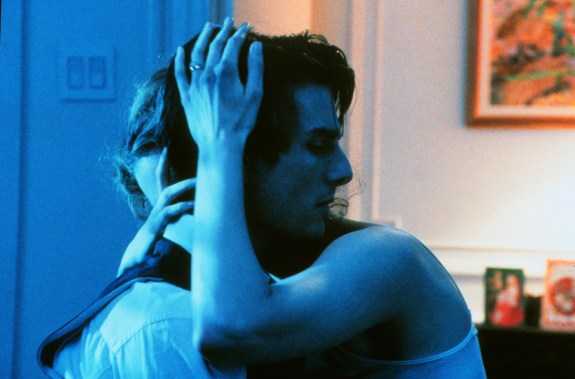
(spoiler alert)
It would be strange to find someone who hasn’t already watched Eyes Wide Shut (Stanley Kubrick) in 2011, but what is commonly found are a chain of reviews – deep in dissection of Kubrick’s last realized masterpiece. But this is no surprise, I’ve seen the film for the second time over a month ago and I’m still trying to sort through my brain, I can still feel its impact, hard and definite, churning in my stomach. The film itself seems mostly void of opinion (not entirely, but mostly), serving more as a general statement and commentary than any specific moral warning, but the questions it inspires are very strong. Kubrick is known to layer his films with meaning through aspects of music, visual appeal, dialogue, and expressions. And by the end, usually nothing is left clear. From an objective standpoint, Eyes Wide Shut does exactly this as it provides no answers, no justification for humanity or for redemption, but leave us with a certain message, a message that depends entirely on the viewer to empathize.
The story behind the story goes back to a personal history with director Stanley Kubrick, who died during the making of Eyes Wide Shut, and because of his propensity to change his films, the prospect of this one not having been the final product intrigues many including me. Kubrick died of a heart attack when he was 70 years old, but the Great American Conspiracy Theory would have it that the film is filled with references and symbology of the Illuminati and that he was murdered for revealing too much. But whatever the reason, he has managed to create a brief but powerful list of films during his lifetime.
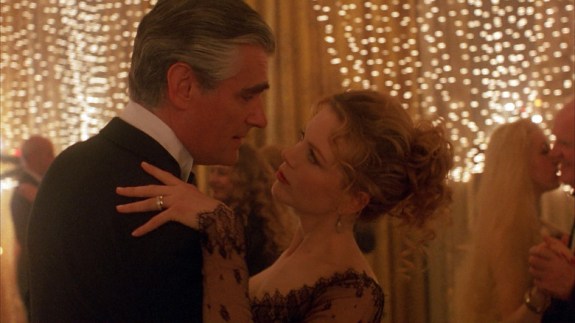
Eyes Wide Shut is visually intoxicating – evident in such artisanal qualities as the old-fashioned sound track, the grainy photography, exquisite color balances and the ambiguous dream like crosses between fantasy and waking reality. The film gives an honest look into human behavior and interaction, skillfully acted by the leads – Nicole Kidman and Tom Cruise – who at times reminded me of Malcolm MacDowell in ‘A Clockwork Orange’.
I won’t attempt a full synopsis, but I will outline chunks from the first half of the plot to help me make a point. The film opens with Bill (Tom Cruise) and Alice (Nicole Kidman) Harford dressing for a party, hosted by the wealthy Victor Ziegler (Sydney Pollack). Bill is a doctor and Alice used to work as an NYC art gallery curator. As they arrive at the party, they split up. Bill finds himself in the company of two models and Alice is hit on heavily by a Hungarian man. Bill is then called away to help Ziegler with a woman who has OD’ed on coke and heroin. Soon after the married couple decide to leave the party and go home. The next night, after putting their daughter to bed, they smoke a joint and end up arguing about the promiscuity both got into at Ziegler’s party. Alice begins to challenge Bill’s total confidence in her faithfulness by telling him a story about her passionate attraction to a naval officer she glimpsed only briefly when they were at Cape Cod with their little girl the previous summer. A phone call interrupts her confession and Bill is called away to do a house visit for a patient that just died. Bill’s night ends up being one failed attempt at cheating on his wife after another until he meets up with an old friend who tells him about a secret party and gives him the password – fidelio – to what turns out to be a ritualistic Venetian-masked orgy in a huge estate outside of the city. The rest of the film follows Bill as he deals with his experience at the orgy after he is caught as an intruder at the private party.
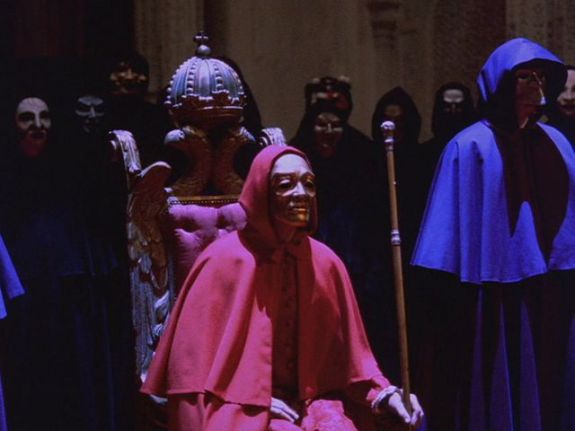
When Bill arrives home, he wakes Alice from a nightmare. She recounts an erotic dream that reference to Adam and Eve. A counter balance to the dream is the analogy of the mask, about the story of temptation, in which we hide behind a ritualized facade, a charade, and somehow, Kubrick manages to transform the story into a comment on status and rank in society. Bill is perceived as an impotent in his attempts to cheat and learns himself to be a second class citizen to the elite that attend the orgy. Every interaction he has throughout the film maintains a sexual layer and yet he fails to succeed, to copulate. Thus masculinity is portrayed as frail, and the level of female nudity and voyeurism also objectify woman as sexual objects.
Eyes Wide Shut makes a strong commentary on modern life, and remains a rare movie that dares to examine sex as compassionately as any other issue. It is a meditation on sexuality and how it relates to topics of commitment, marriage, love, and death. Regardless of all the skepticism, it is a film that has the power to plant a strange seed inside you, one that draws you back into thinking about its lessons long after viewing.
 hilitehead
elaborate?