
Being your slave what should I do but tend
Upon the hours, and times of your desire?
I have no precious time at all to spend;
Nor services to do, till you require.
Nor dare I chide the world without end hour,
Whilst I, my sovereign, watch the clock for you.
(Shakespeare, Sonnet 57)
Can we capture the moment of now? or now…or now…its impossible, the forces of time are much too great for us to capture, let alone understand as it continues to silently ping in our minds and across space. To mark the first day of September, I dedicate this post to Christian Marclay and to his notorious film installation ‘The Clock’ – a 24-hour montage of “thousands of film and television clips with glimpses of clocks, watches, and samples of people saying what time it is”, or more obliquely conjure up the passage of time. The installation was masterfully edited and sampled down to the micro-seconds to match the actual time of the instant; it is ticking as I write and as you read. The accuracy of The Clock is synced to the finest detail of our current settings while also reflecting on the notions of time in the cinema, and indeed in life itself as the whole thing functions as a gigantic and gloriously impractical clock.
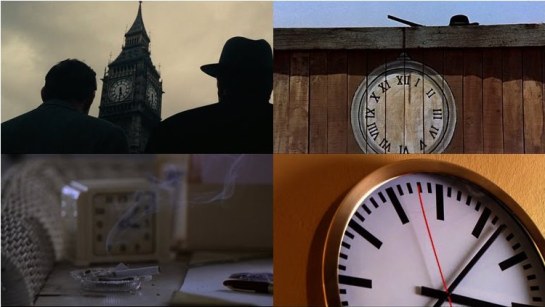
Since it debut back in January of 2011 at the Paula Cooper Gallery, The Clock has been making its way around the world at such famous museums and galleries alike, including Hayward Gallery (London), Los Angeles County Museum of Art, Corderie dell’Arsenale (Venice), and White Cube (London). For his noteworthy piece, Marclay was awarded the Golden Lion for the best artist at the ILLUMInations Exhibition in the 54th Venice Biennale this year. I only wish I can get to see this most revered film as it makes its way to the Museum of Fine Art in Boston next on September 17th, but its near impossible for anyone to experience the 3 day 24-hour ‘pricey’ screening or even the screening during regular museum hours since the MFA is only accommodating a total of 48 visitors at a time. So I’ve decided to share a viewers experience wonderfully described by Peter Bradshaw of the Guardian:
[You have to settle into The Clock, and go into the extraordinary trance-like state that it induces. When I first arrived, I found myself giving a little amused laugh at each appearance of the time. Then the novelty wore off and I became silent. Some other people, arriving after me, went through the same process. I arrived just after 11 in the morning and left before 1pm, so I went through the midday climax of emotions: I expected, and got, Gary Cooper in High Noon. Then there were a lot of shots of clocks and watches and lunchtime and people wondering if it was time for lunch. There were, generally, a large number of shots of Big Ben and large institutional clocks, lots of scenes of people hurrying for trains, late for trains, early for trains, hanging around on platforms. The Clock might turn out to be one of the great train movies.
Sometimes the time is just glimpsed in the background of a shot, irrelevant to the action and sometimes the time gives a sharp stab or poke to the dialogue: particularly with scenes in which time is running out. The Clock is, unexpectedly, quite a sensual, sexy film, in that the late morning stretch features plenty of shots of people in bed, waking up, embracing and then realising that these are forbidden pleasures – forbidden by the clock. (“What’s the time? Is that the time?” etc) The time is an alarm clock, a constant silently pinging alarm clock.
For me, the weirdest effect of The Clock is that the time references became fictional – I stopped noticing that they were telling me exactly what the time actually was. They became a series of numbers which ordered the mosaic of moods and moments. And then, slowly but surely, I stopped noticing the time entirely. I just drank it in, just accepted the juxtapositions.]
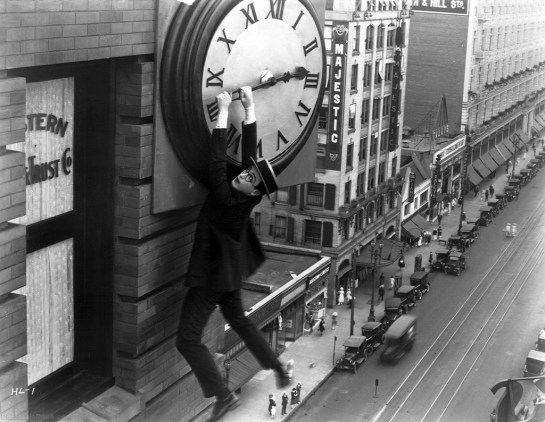
The Clock assures a portrait of our world as reconfigured; one in which time stands still for no man. Marclay states, “there is an anxiety within the film which keeps viewers connected, and as you watch you are also conscious about real-time and this anxiety colors the entire film experience for how you see time as universe, time passing mortality, and time as a giant memento mori”. The whole project took him about two years to make and you wonder why it didn’t take longer. But Marclay has made such visual mash-ups before, but his latest project remains one of his most controversial and publicly accepted pieces, “elevating his mainly sound-related art to a stratospheric new level.”
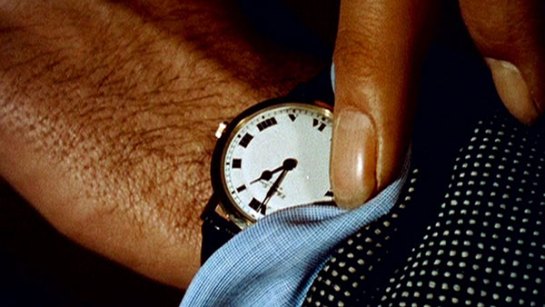
So what does it mean? Time has become such an oppressive element in our daily life; something we can’t escape from. But our microscopic interest in time is a fairly new phenomenon and only in the last two hundred years or so have we become overly possessed by macro seconds. Is society at fault? maybe so as capitalism continues to guard time preciously – using it as a value for production and financial value, and as a result, time has become oppressive, something we continuously aim to lease, tame, and conquer. So how do we escape the tyranny of time and go back to its primordial innocence? only when we do things we love do we occupy our minds and lose sense of time. But with that said it would also be pointless to lose track of time, after all, recognizing the value of its finite commodity helps us to plan our life, ideally for the better. As our clocks tick away, we are reminded daily about the use of our finite days.
 hilitehead
elaborate?