
Ask a Mongolian
There is always standards for beauty, what kind of standards do Mongolian men and women have? How is beauty defined for men and women in Mongolia?
(Zolzaya T)
and to this I answer…
This is a great topic and to properly address your question, I must briefly explore the topic of beauty to better clarify my point. So what is beauty? How do human beings decide who is attractive and who is not? Beauty is a visual stimuli. It is experienced through both conscious and unconscious decisions. Great thinkers and artists of our time have proven that there is no universal standard for beauty, and while we instinctively know what appeals to our sense of beauty, defining what determines attractiveness is not always easy. After all, beauty is a matter of personal opinion and depends largely on the eyes of the beholder. However, society today is full of messages telling us what is beautiful, creating such prototypes, and I often wonder what these definitions are based on. Science has thus far discovered that symmetry and scent play a large role in defining human attraction, but while this can begin to explain beauty on the most basic of levels, the standards of beauty differ within each culture and over time.
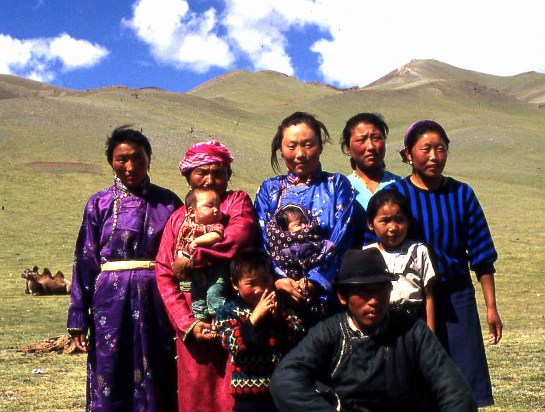
(Above: Women of the Mongolian countryside)
I believe that one should never confuse personal attraction with society’s beauty standards, but this is not always the case. Without a doubt inner beauty is the best way to judge somebody, however in the increased material world of ours today, the physical appearance is revered over its counterpart. And as cliché as it is, what good does it do if someone is attractive on the outside but lacking personality wise? appearances thus allude.
Like most societies, Mongolia fall prey to this societal standard, and though I can’t speak for everyone, Mongolia has become increasingly image conscious since the brink of the new millennium, with a public that is under constant pressure to maintain an impression of decorum and prosperity despite reverses. Most societies in the world face such pressures, but at least their economy is able to redeem the losses. Mongolia on the other hand remain a small nation with a developing economy whose demands for social conformity, material and other wise, far exceed the household income for a nation in poverty. Of course the world is globalizing and without a doubt Mongolia is prone to social changes, but not all change is good when it comes to the loss of tradition and culture. I often think about how difficult it would be for me to live in Ulaanbaatar, not so much because of the cultural transition but because I refuse to comply and be judged based on such derogatory ideals. Only over a century ago, Mongolians lived a traditional lifestyle, with beauty standards that originated from native grounds. Men and women were accepted as beautiful for all their distinct Mongoloid features and traditional clothing. But since the later influence of Communism and of Western capitalism, the arena of globalized entertainment and globalized beauty have surged through Mongolia, extensively affecting the ideals of ‘what is beautiful’ for the majority.
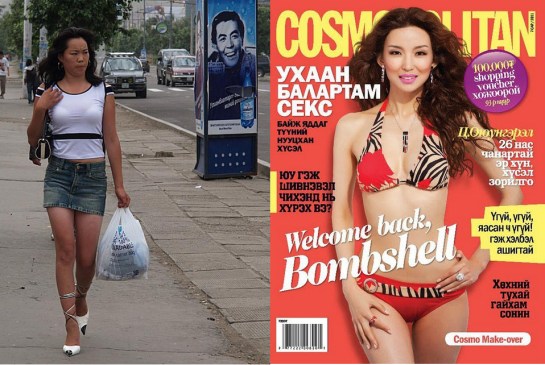
(Above: Women in Ulaanbaatar and Mongolian top model Oyungerel)
But the effects of the Western entertainment industry proliferation is widespread over the world, weighing a heavy influence on the beauty ideals of majority Asia. The complexity of the matter is deep and universally controversial, tracing back to societal and class roots, yet many Asian men and women continue to strive for ideal Eurasian features; even resorting to extremes of surgery in order to eradicate their cultural traits. In the past couple years, beauty ideals in Mongolia have also reverted to opposite means, where being ‘attractive’ is no longer just an option, but a matter of necessity that one must possess in order to afford a moderate living. Take for example the Mongolian job market which requires every applicant to acquire at least a collegiate degree, speak two languages or more, and possess supermodel like features. But not everyone is packaged to fit societies mold, and to survive in Mongolia one is forced to resort to a few options; to plasticise ones self and redeem a worth, or bribe ones way through if you have the funds, or sleep ones way through if your conscience allows. And for anyone over the age of 40, the chances of acquiring a decent job is near impossible. You can of course bluff the market if you prove your extraordinary value, but this is rare, and I’m generally referring to the greater Mongolian public in this post.
WOMEN
The standards of female attractiveness in Mongolia is similar, if not completely alike, to most Asian cultures. Since the rise of the ‘Korean Wave’ in 1999, following an import of Korean entertainment frenzy, the Mongolian public started to model themselves based on South Korean beauty standards. The most common standards for Mongolian women range from a desired height, oval face, thinness, pale complexion, large eyes with eyelids, and a pronounced bridge of the nose. In the quest to attain a ‘symmetrical face’ many women undergo cosmetic surgical procedures, with the most common being eyelid surgery, nose-reshaping, and facial contouring. Plastic surgery is seen as taboo for many Mongolians by cultural standards, but media aim to prove otherwise.
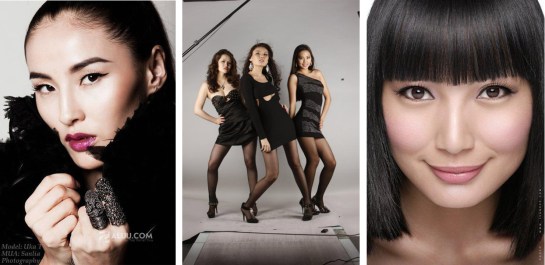
(Above, from left: Mongolian models Udarmaa, Purevdulam, Bolormaa)
PLASTIC SURGERY
In the past, Mongolian women would traveled abroad to Korea, China, and various Southeast Asian countries for their cosmetic procedures, but as of recently, the business of plastic surgery has sprouted throughout Mongolia. In fact ‘medical tourism’ remains a popular attraction for many Mongolian woman, ever more so now than before. Medical tourism was first publicly introduced to Mongolia in 2009 through a controversial TV segment on Mongolian top model Urantsetseg Ganbold, who became the first known cover model for Korean medical tourism company KJ. On her TV appearance, Urantsetseg openly revealed details of her plastic surgery procedure while promoting the Korean KJ company. In America, plastic surgery shows are a many and though controversial the public has somewhat come to terms with the subject. However in Mongolia, model Urantsetseg’s surgery stunt marked the first time that such a taboo subject matter was broadcast publicly and dealt with so candidly. The reasons for why she accepted a free offer to reconstruct her native face to resemble that of a Korean facial prototype may be her own, but using her fame to encourage self loathing, and hatred of ones own cultural traits upon the many Mongolian women is by far despicable. The program sends a toxic message to the mass, one that will travel a long way to create many body conscious girls in the future.
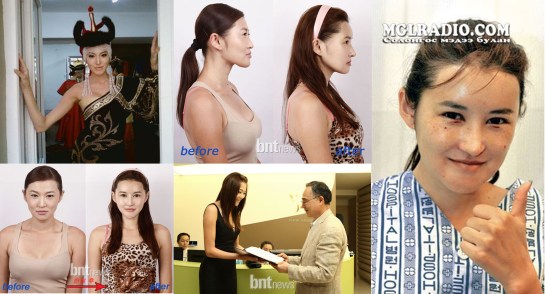
(Above: Mongolian top model Urantsetseg)
Native beauty standards are specific to the culture and climate. Mongolian woman are born and raised in arid conditions possessing such distinct features as high cheek bones, coarse black hair, eyelashes that slant down, a wide face, and eyes with epicanthic folds. These features generate from a line of ancestral DNA, encrypted in the blood and distinct to the days when women worked as herders, living in the harsh countryside climate. Yet how can one distinguish such prominent traits as ‘bad/ugly’ and strive for a different cultural trait as ‘good/beautiful’? If the beauty norm in Eastern Asian is defined by the fairness of the skin, and by the small size of the face, can-not the Central Asian norm be defined by other factors?

(Above: Mongolian long song singer Uran)
SKIN BRIGHTENING
‘A preference for lighter-skinned women has remained prevalent over time, even in cultures without European contact’. Anthropologist Peter Frost states, ‘since higher-ranking men were allowed to marry the perceived more attractive women, who tended to have fair skin, by sexual selection the upper classes of a society generally tended to develop a lighter complexion than the lower classes, whose darker skin was associated to a life of outdoor labor toiling in the sun.’
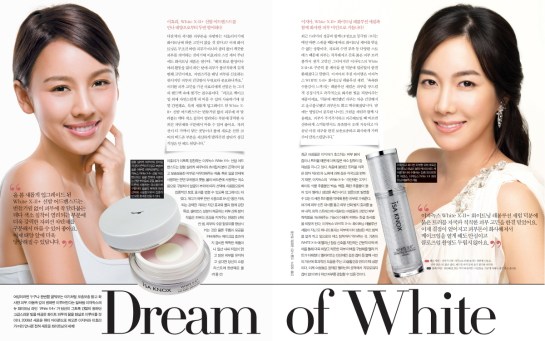
Being fair is considered beautiful in many Asian cultures, it is viewed as a symbol of innocence and femininity. Using such skin whiteners are also common among Mongolian women to achieve clear, white or pale complexion, while also avoiding exposure to the sun whenever possible. Around the 70’s and 80’s, when cosmetic products were sparse, Mongolian women would resort to extreme methods to bleach the skin. A common trend was the use of skin eczema cream on the face whose bleaching contents were so high that it acted as a peroxide agent, while others would resort to dissolving tablets of vitamin c in water and using the solution to cleanse the face in hopes of achieving a lighter complexion. Only in the 1990’s was Mongolia first introduced to global beauty products, when the import/export business flourished following the change in governments.
EYE ENLARGEMENT
By contrary belief, many Asian woman tend to be self-conscious about their epicanthic folds, also called the Mongoloid eye fold, which is a skin fold of the upper eyelid that covers the inner corner of the eye. Many Asian women go to extreme lengths to change the appearance of their eye lids, from high-maintenance temporary alterations to more expensive and permanent options.
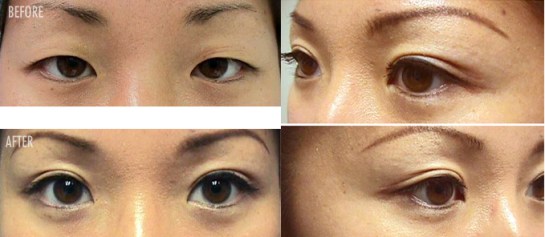
Most Asian women spend their lives coveting the Caucasian ‘double fold’ eyelids. “Young girls often start off with cheap and easily accessible apparatuses for achieving double-fold eyelids such as tape or glue to make ‘pleats’ in their own skin.” In the 80’s, Mongolian women would also use various tapes to mimic an upper eye crease, but today women prefer eye enlargement surgical procedures as more of a permanent means to achieving Western eyes.
NOSE
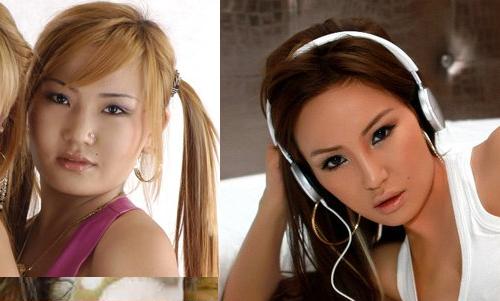
Mongolian men and women typically have a less defined nose line than the Caucasian counterparts while some Mongolians from the Northern provinces tend to have a tall Western like nose. Most Mongolian women seek to pronounce their nose bridge in order to achieve a higher and straighter looking nose, and due to their already Mongoloid features with the “absence of a brown-bone”, the differences of a higher nose can usually result in a more Western facial prototype.

(Below: Mongolian pop singer Anu)
BODY TYPES
Body mass remains an important determinant to the perception of beauty globally. In majority of Asia, women tend to have a naturally slim physic depending on their bone structures, dietary staple, genetics, and environment. Comparably, Mongolian men and women tend to be ‘taller with longer torsos’, but the body proportions vary according to each province.
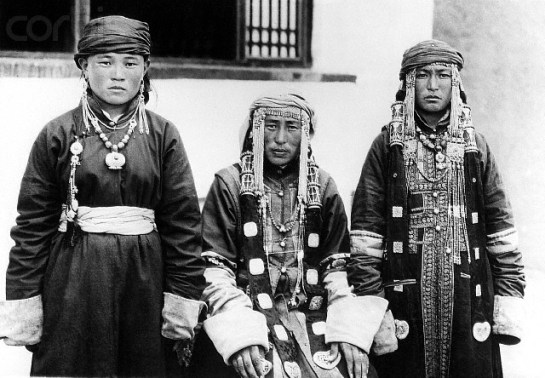
(Above: Mongolian women in traditional clothing)
John Relethford, author of Human Species, claimed that Far East Asians tend to have shorter limbs relative to their torso length than South East Asians, although they tend to have bigger bodies.
Ashley Montagu, author of Growing Young, lists the Mongoloid features pertaining to a ‘Larger brain, larger braincase, broader skull, broader face, flat roof of the nose, inner eye fold, more protuberant eyes, lack of brow ridges, greater delicacy of bones, shallow mandibular fossa, small mastoid processes, stocky build, persistence of thymus gland into adult life, persistence of juvenile form of zygomatic muscle, persistence of juvenile form of superior lip muscle, later eruption of full dentition (except second and third molars), less hairy, fewer sweat glands, fewer hairs per square centimeter [and] long torso’.
The traditional Mongolian dietary stable is based on three main ingredients; meat, flour, and milk. And for many centuries this basic meat-dependent diet was essential to survive the climate, as it replenished the nomadic herders from the cold and long winters. Thus men and women tended to possess ‘plump’ figures, and such things as ‘body fat’ were never considered an issue of beauty, but rather an indicator for good health. And even up until the Soviet regime, Mongolia remained fairly sealed from outside influence and of the global food markets. But since the change of government systems in 1990, Mongolia became undisclosed to global information and the flow of exotic food imports slowly changed the dietary staple of the entire country. Women were now under the age-old pressure to be thin, while the chiseled physics of Western bodybuilders and Hollywood hunks influenced men alike.
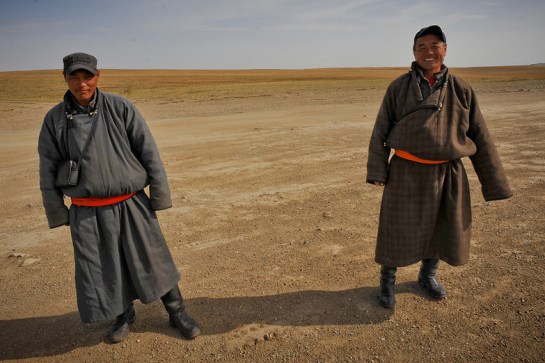
(above: Mongolian countryside men in traditional clothing)
REFLECTION
I am very proud of my Mongolian traits, but without a doubt I’ve also felt outcast and sometimes pressured to look a certain way, and I still do living in America. In my youth, I admit I’ve resorted to certain measures to ‘blend in’ more with the crowd; such as bleaching my hair blond, or wearing colored contacts, but through the years, I have certainly come to accept and better understanding my self and cultural significance. Of course I still take certain measures to fit in on some scope, sometimes unconsciously, sometimes consciously, and as much as I perceive not to, this is sort of an inevitable human trait we cant escape from. The point is then, to try and understand our globalizing self and cultural roots in order to better settle with our identity. After all, we are only distinctly breed one in the entire universe.
It hurts me to hear about Mongolian women who are ashamed of their cultural identities, since in time, the able ones usually receive some form of plastic surgery to disguise, while others manipulate their photos to mimic desired illusions. But the idealization of beauty is not worth losing ones cultural or self value over. The glory days do surpass at one point or another, and at the end of our days, we all grow old and slow. The question then remains in whether or not such idealized beauty perceptions would matter at later points of our life when everything comes to perspective. I for one would not think about the evanescent ways in which my beauty was prevalent, or how many people I left in awe with my beauty, but rather of the memorable moments and significant periods in which I made use out of my life.
You are beautiful the way you are
Stay tuned for part II on the beauty standards of Mongolian men!
[Research sources cited 1, 2, 3, 4, 5, 6]
[Image sources 1, 2, 3, 4, 5]


 hilitehead
Leave a reply to Herman Cancel reply