
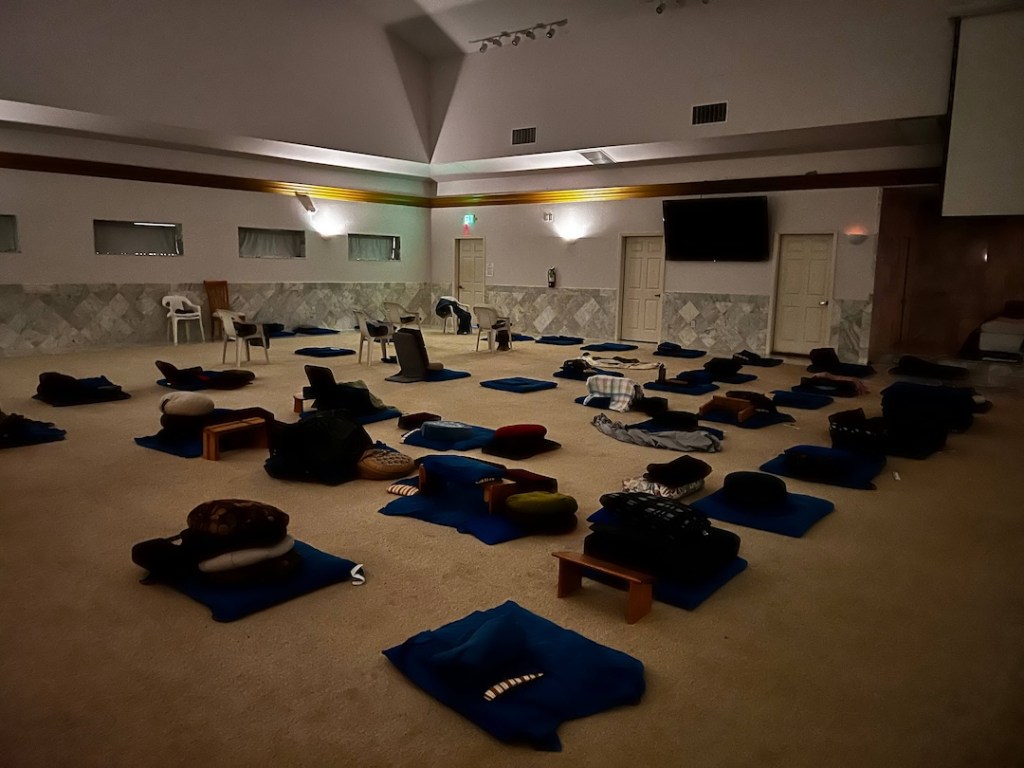
On returning to Vipassana a decade later and the epiphanies the silence surfaced. Dispatches from the Dhamma Kaufman Vipassana Center, Texas — May 2026
👉 This article was featured on Reality Sandwich check it out!
A Decade Later
Ten years is a long time to carry something without returning to its source but a fleeting blink in a quantum leap.
The first time I sat a Vipassana course was at the Dhamma Sela Rocky Mountain Vipassana Center in Elbert, Colorado a decade ago — a younger version of myself in a different chapter of life, encountering the practice for the first time with the particular mixture of curiosity and resistance that marks every genuine first encounter with oneself. Frankly, I don’t fully recall all that went on during my first Vipassana in 2016 — which is perhaps its own testament on how much was actually happening beneath the surface — except the memory of grueling physical endurance around 100 hours of sitting. What I carried out quietly this time stayed with me the way the best things do: not as doctrine, but as a kind of interior compass that occasionally reminded me of its existence.
In May 2026, exactly ten years later, I returned.
The timing was not accidental — or rather, it was the kind of synchronicity that stops feeling like coincidence once you understand that the universe arranges its invitations with more precision than we typically credit. I was at a crossroads of significant personal transition, having moved to New York City in 2023, undergone a deep spiritual awakening that began earnest in 2025, and accumulated — in the accelerated, ruthless way that big cities and awakenings tend to produce — a full spectrum of shadows, traumas, and unprocessed material that had not yet been fully digested. The course arrived not as an escape from any of this but as a container in which it could finally be seen.
There is also a larger context I cannot ignore. The years we are living through carry a particular quality of pressure and acceleration — what many in consciousness and cosmological circles are naming the New Earth transition, a period of collective frequency shift and the surfacing of everything that cannot survive in higher light. The symptoms are not subtle: nervous system dysregulation on a mass scale, the collapse of systems built on concealment, the intensification of both shadow and illumination in equal measure. Ascension, whatever tradition you approach it from, is not comfortable. It is a process of shedding — and shedding, as any snake on a Texas forest path will tell you, requires stillness.
Vipassana, this second time, arrived as exactly the soul medicine it needed to be — a profound nervous system reset and detox, precisely timed within the larger context of planetary ascension and collective frequency shift. Its deepest gifts were permission, release and surrender. Permission to see the entire ouverture of my recent years — the shadows accumulated, the choices made, the versions of myself that moved pre, through, and now post New York’s particular crucible — to see all of it clearly, without flinching, and to arrive at something I can only call unconditional self-acceptance. To forgive myself completely and wholly, to surrender to what is basking into the the all accepting source consciousness that has always been there with a perspective shift on allowing, trusting the magic of life to unfold organically without the paranoiac need to attach to and control outcomes. To stand at the threshold of what comes next as a lighter being co-creating with the universe with nervous system intact and walking forward.
What Vipassana Actually Is (And Is Not)
Vipassana, meaning “to see things as they really are,” is one of India’s oldest meditation techniques traced back more than 2,500 years to the time of Siddhartha Gautama, though it predates Buddhism as a specific religion. It was reintroduced to the modern world largely through the work of S. N. Goenka, a Burmese-Indian teacher who began teaching in the 1960s and whose recorded discourses now anchor every course at every Goenka center worldwide.
The technique itself is deceptively simple in description. For the first three days, students practice anapana — sustained, close attention to the breath, specifically the physical sensation of air moving across the upper lip and nostril. On Day 4, the full Vipassana practice is introduced: a systematic scan of the entire body, head to toe and back again, observing every physical sensation — heat, pressure, tingling, pain, pulsation — without reacting. No craving for pleasant sensations, no aversion to unpleasant ones just pure, equanimous observation.
The premise is philosophical before it is practical. Goenka’s framework holds that every mental reaction — every craving, every fear, every resentment — arises first as a physical sensation in the body. Thoughts and emotions are considered a downstream of sensation. By training yourself to observe sensations without reacting, you are dissolving, at the root level, the automatic chain that produces reactive behavior. The technique operates on what Buddhist psychology calls sankhara: the deep seated mental formations that condition everything we think, feel and do.
Vipassana meditation is not visualization, affirmation or guided relaxation. It is in the most precise sense, a laboratory for self observation. However what surfaces in the laboratory is not always what you expected to find so its important to remain unexpecting and unattached to whatever will rise to the surface knowing that whatever does surface is what needs to be addressed to be healed, to be felt wholly and released.
It strikes me that our culture places immense emphasis on physical health and exercise, yet speaks far less about the necessity of training the mind itself — even though the mind precedes and governs the body as the primary command center of human experience.
I’m learning that meditation is a practice of disciplined, persistent observation — one that places us in the position of the witness, no longer compelled by the urgency to react, but instead able to respond from stillness and clarity. Through this practice, a kind of inner stability emerges: an energetic resilience that is no longer easily penetrated by passing emotions, distractions or external chaos.
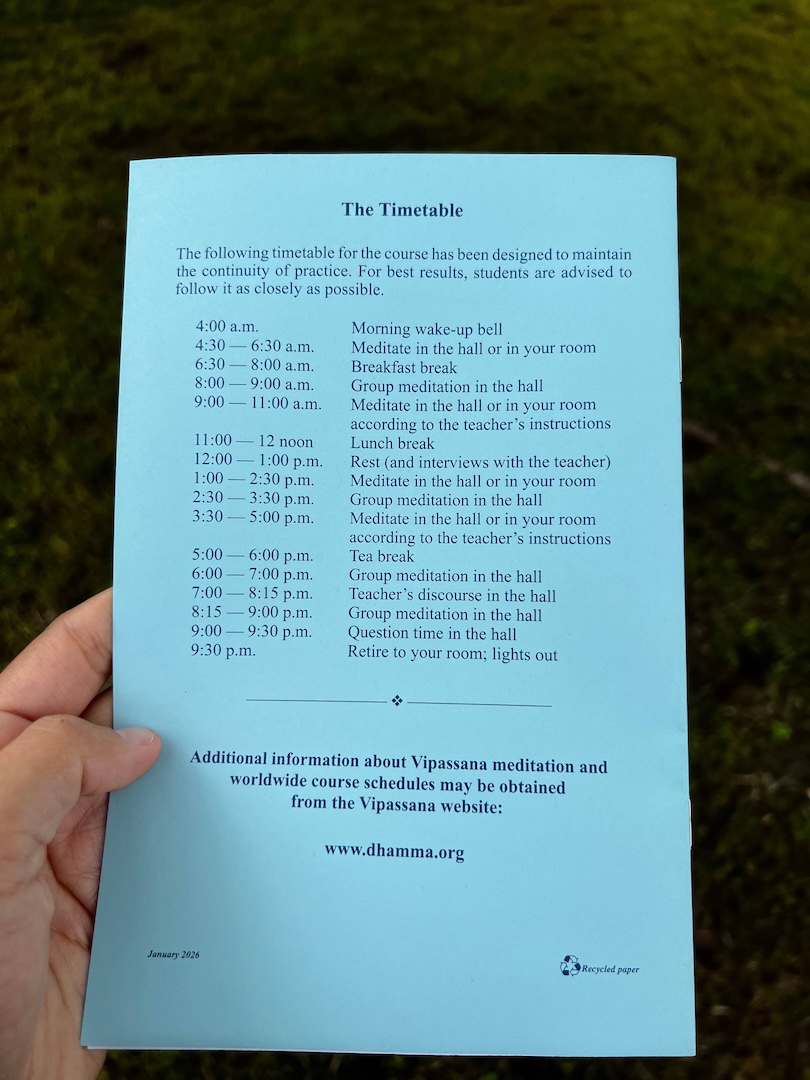
The Architecture of a Ten-Day Course
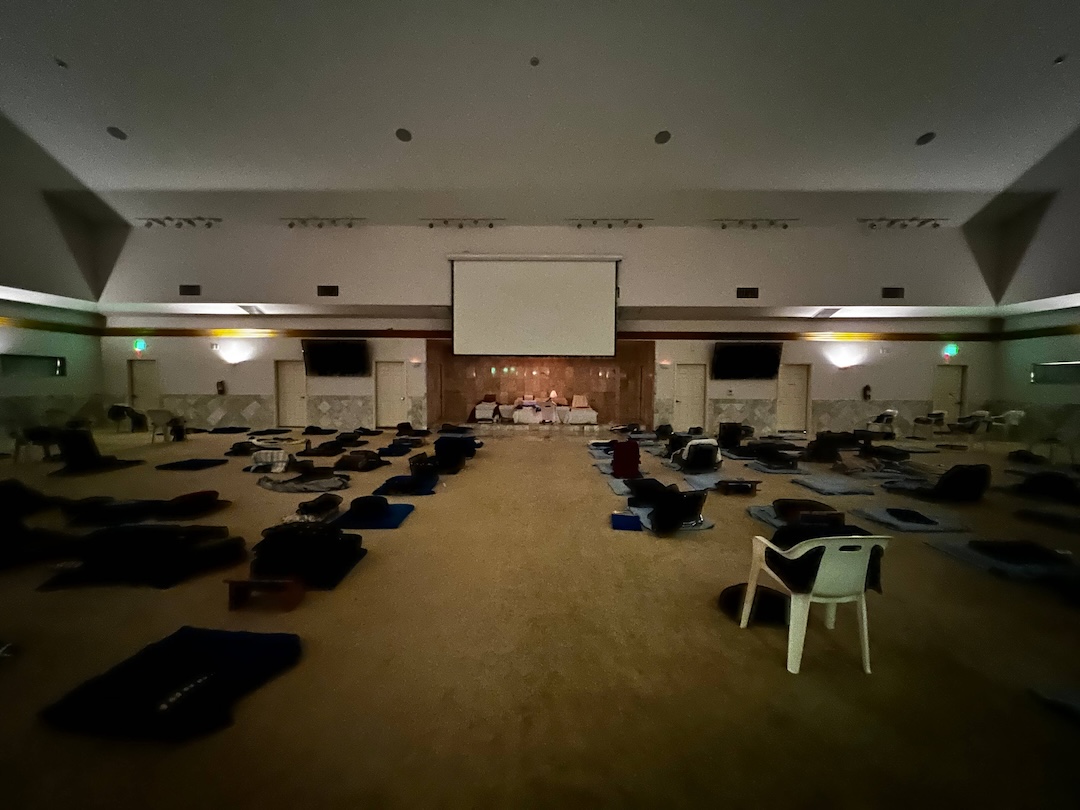
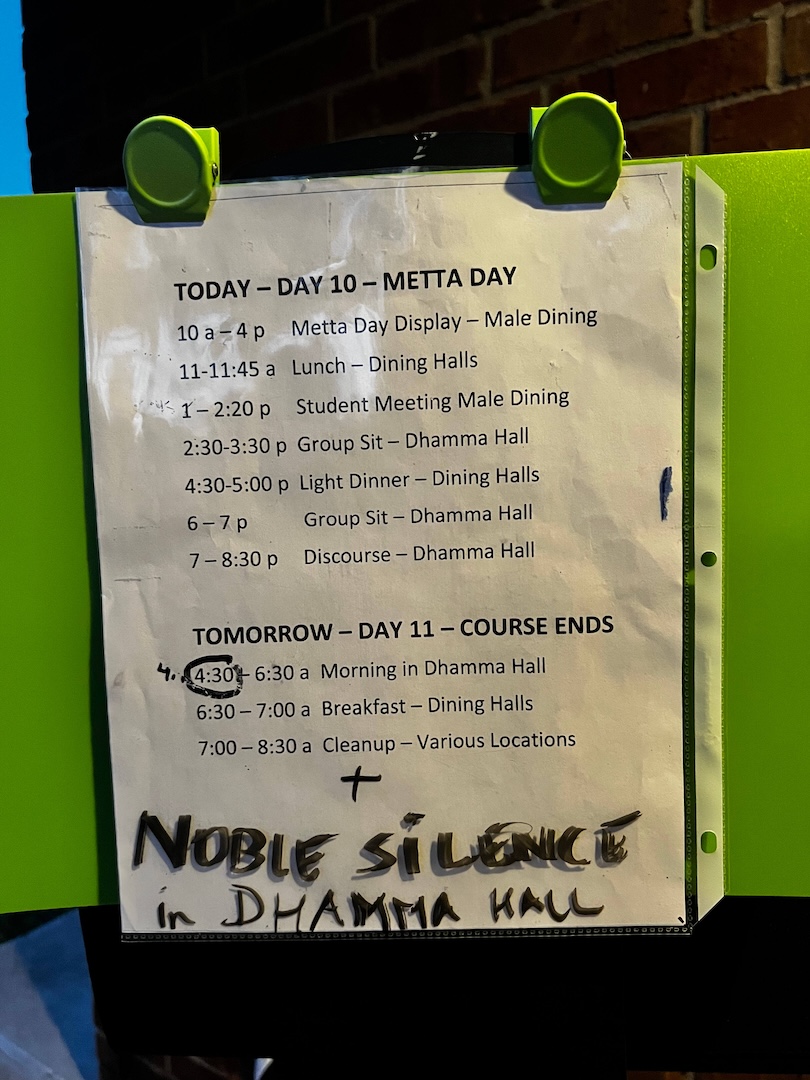
The structure is total and intentional. Students observe noble silence for the duration of the 10 day course — no speech, no eye contact, no reading, no writing, no devices. You wake at 4am, meditate from 4:30am to 9pm with breaks for meals and rest then sleep at 9:30pm.
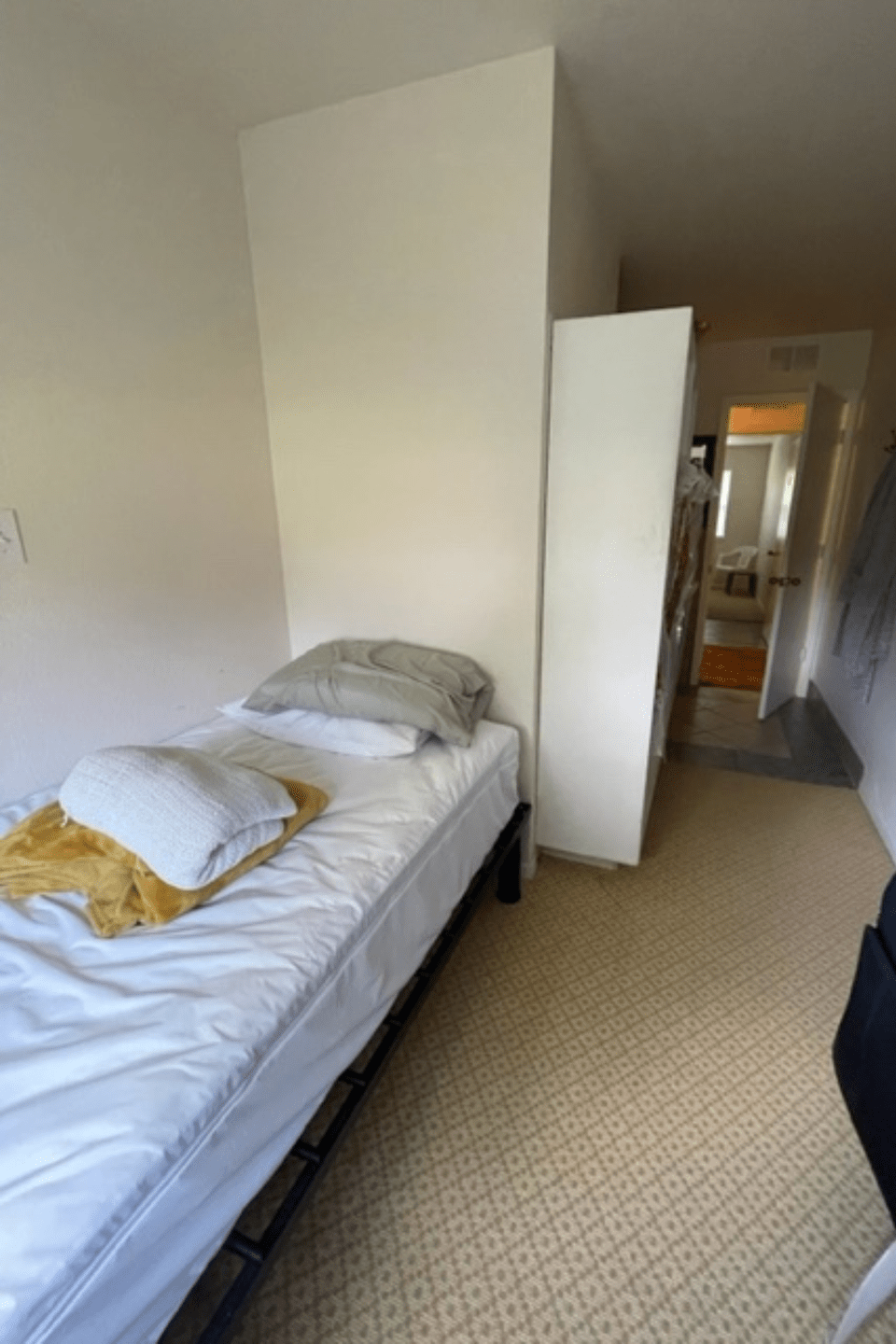
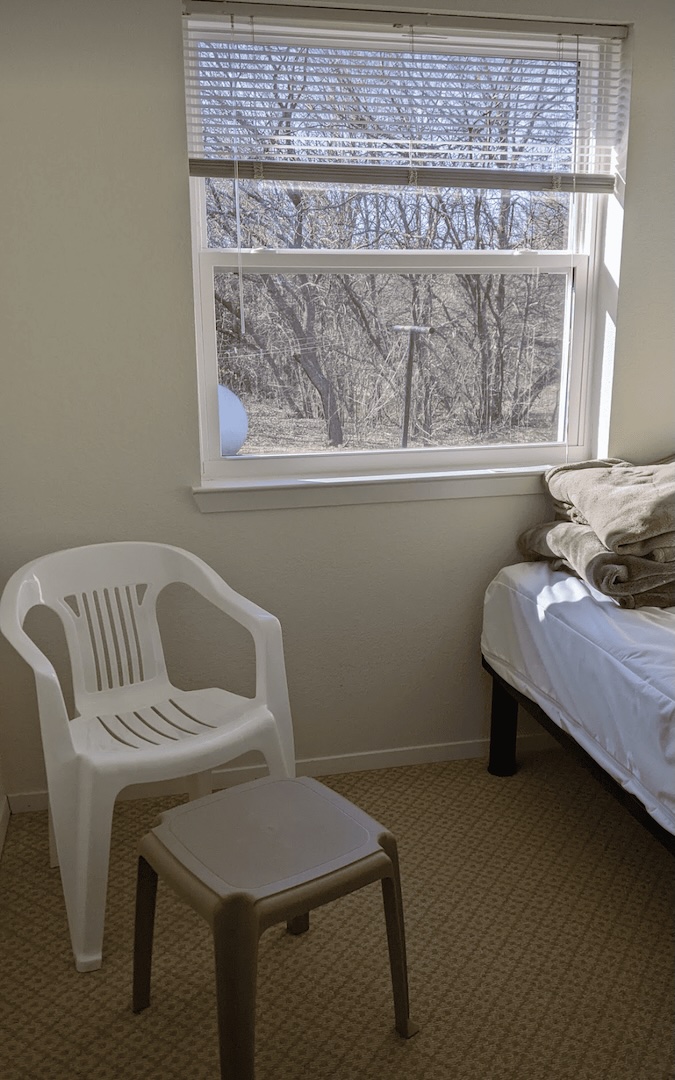
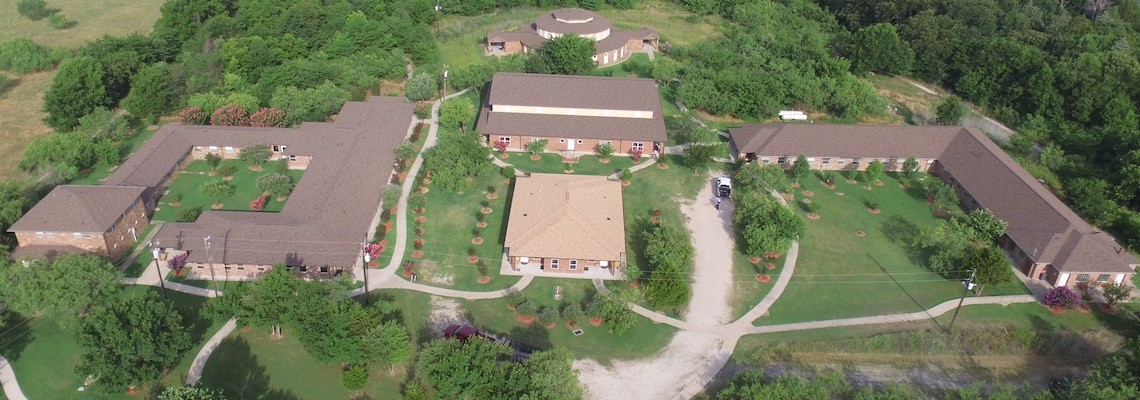
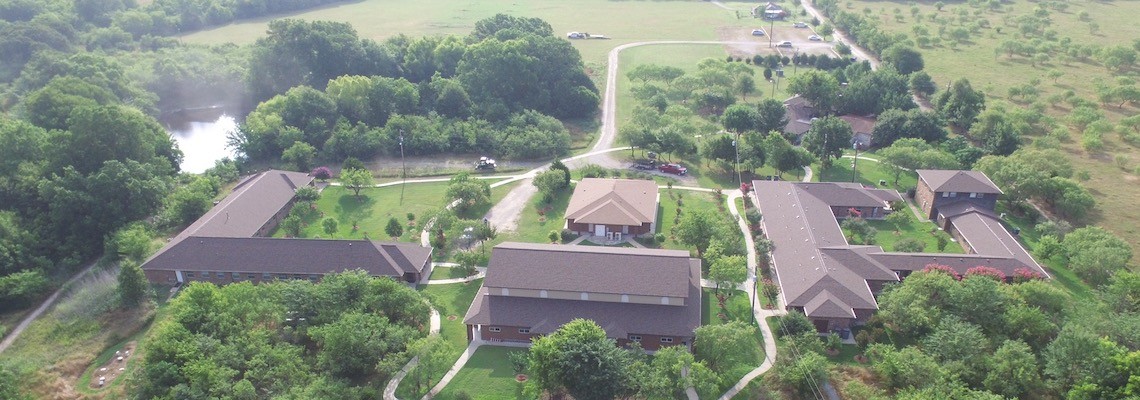
I was highly impressed by the Dhamma Siri Southwest Vipassana Meditation Center, which stands out as one of the foremost purpose built Vipassana facilities I’ve encountered. Its infrastructure felt intentionally designed to support silence, discipline and inward focus. In comparison, the Colorado center operates out of a rented Boy Scouts campus, making much of the environment communal and limiting privacy. The difference in spatial design and atmosphere significantly impacts the depth of immersion and overall retreat experience.
The Kaufman center sits on flat plains with outlines of green forest at the perimeter — male and female quarters strictly separated, private rooms, walking paths within marked course boundaries. The architecture of the experience is designed to strip away every external variable until only the internal one remains. There is nowhere to go. The only frontier available is the one inside.
This matters because the cultural context most of us arrive from — the American attention economy, the perpetual scroll, the curated performance of identity across platforms is precisely the opposite of what Vipassana asks. We have been conditioned, systematically, toward distraction and constant stimulation. The course is a full counter conditioning. On day one this feels like deprivation but by day five it begins to feel like medicine.
What the Silence Surfaces
Welcome to the mental olympics. The first three days are a mental battlefield. This is not metaphor — it is the most precise description available for what early Vipassana initiates in the unprepared mind. When external stimulation is removed, what rushes in is everything that stimulation was helping you avoid: unresolved memories, postponed grief, old decisions never fully examined, repressed traumas, the residue of years of moving too fast.
The practice does not ask you to resolve any of this. It asks something stranger and more radical: to observe it. To feel it arise without following it, without labeling it good or bad, without running from it or clinging to it. The Vipassana teaching on impermanence — anicca, in Pali — is an instruction on everything that arises as passing. The sensation in your knee, the anger, the grief, the exhilaration. You are being asked to watch the entire film of your inner life without clutching at any particular frame.
What becomes clear, over the course of those ten days, is that this watching/the observation is itself a form of release. The emotional charge a memory carries is not in the memory itself but in your relationship to it — in the flinching, the avoidance, the way you move around it rather than through it. Vipassana places you directly in front of what you have been avoiding. For those of us moving through a period of accelerated awakening, this confrontation is not only personally useful — it is cosmologically necessary.
You cannot ascend while dragging the unexamined behind you; one can only rise to the extent at which they have let go of their demons. The shadows have to be seen before they can be released. We are in a time of stark spiritual warfare so what better time than now to dive deeply inwards and self-regenerate root up.
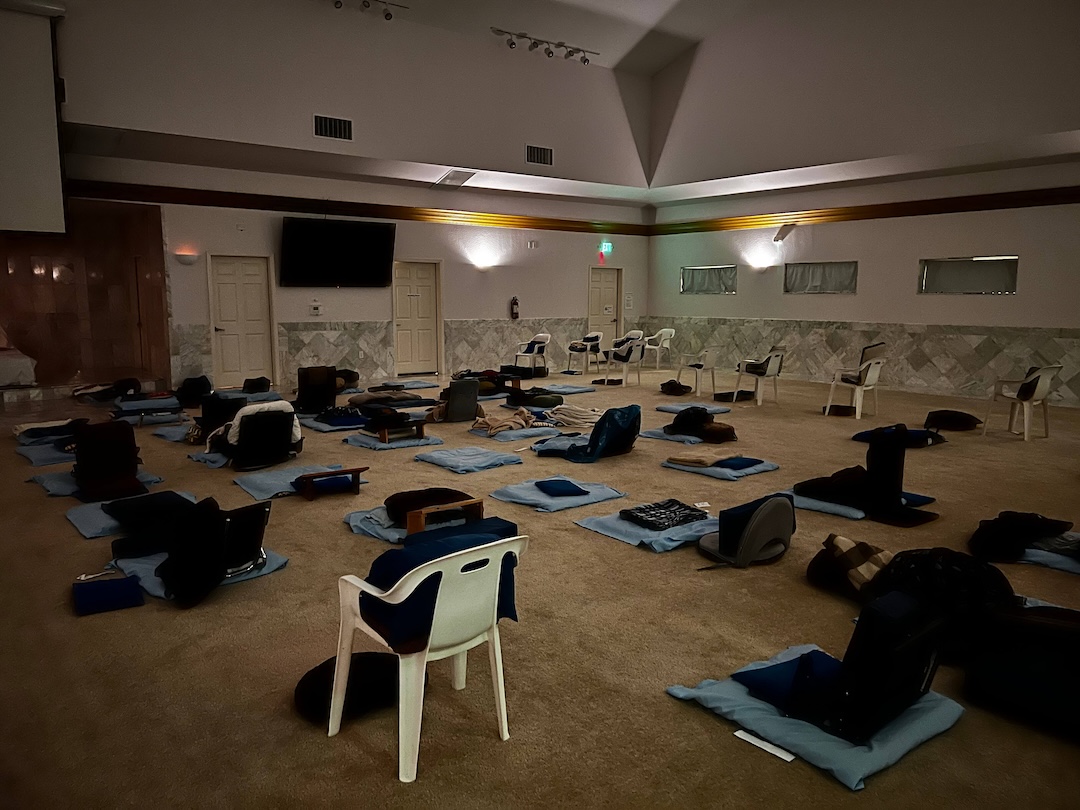
The Body as the Site of Inquiry
What separates Vipassana from most contemporary wellness practice is its insistence on the body not as a vehicle for relaxation or performance, but as the actual site of psychological investigation.
Goenka’s core argument is that the body never lies. The mind constructs narratives, justifies, revises, projects. The body simply registers. By learning to read the body — to feel the gross and subtle sensations that arise in every square centimeter of its surface — you develop a capacity for self knowledge that bypasses the mind’s editorial function entirely.
The Day 4 introduction of full body scanning is the pivot point of the course. Before that day, the practice feels preparatory. After it, the excavation begins in earnest. Students who have been sitting relatively comfortably with anapana suddenly find themselves scanning through layers of sensation they had no language for — and, often, encountering the physical residue of emotions they thought they had left behind years ago. This is the method’s particular genius and its particular demand. You are not being gently led toward insight but being placed in conditions where insight becomes unavoidable.
Three Women, Three Perspectives
I recorded interviews with three women on the final day of the course — each arriving from a different life, each carrying something different into those ten days. What united them was not background or belief but the specific courage it takes to sit down with yourself, unmediated, for ten consecutive days and not look away.
Raksha Adhikari — Dallas, Texas
Raksha is Nepali American, a three time returning Vipassana student who served in the kitchen for this course rather than sitting as a student — meditating during group sittings, otherwise cooking and serving meals for resident students. The dual role gave her a perspective most participants never access.
“Before this, I learned from the sitting that you have to have love and compassion for people, and then you practice that in daily life. But you don’t go to an extent like this in daily life. When you’re serving, you do whatever work is given to you — because you want to. Nobody’s holding you back.”
What struck her most was the way the practice moved from concept to felt reality over the ten days — the teachings on equanimity not as instruction but as something she could embody in her body.
“After three or four days, that love and compassion that Goenka talks about — I could feel it growing in me. Right now, nothing bothers me. Even if somebody’s bothering me right now, it doesn’t bother me.”
Her final word was direct: “Everybody should give it a try — ten days. Even minor, tiny — they will be changed.”
Alice Giaccone — Austin, Texas
Alice is a somatic movement practitioner and teacher which made her, of all the students I spoke with, perhaps the most theoretically prepared for what Vipassana would ask. Somatic practice operates from a similar foundational premise that the body holds what the mind cannot access, and that healing moves through sensation rather than around it. What she did not anticipate was how completely the course would reframe her understanding of her own field.
“I thought: I’ll find concentration, I’ll regulate my nervous system. But I didn’t understand that there was going to be this whole structure for understanding reality. Having the framework of recognizing the cravings and the aversions, and going inward to understand what sensations are arising — that’s been really liberating.”
She brought a practitioner’s eye to the wellness industry’s relationship with these teachings — noting, with unusual honesty, that much of what the West brands as somatic healing is a repackaging of what the Buddha was teaching long before it had a market value.
“The Buddha was teaching somatic meditations before it even had that name. We’ve just repurposed and repackaged a lot of that in the West.”
The course’s structure of voluntary service and dana — offered entirely free, sustained by those who have benefited — prompted her to examine her own motivations as a healer.
“Taking the ego out of my work — I give, I help, but it also makes me feel important. It shouldn’t be about that. Even if I’m not thinking ‘I’m going to get something out of them,’ I’m still feeling special. And that shouldn’t be the reason I’m giving to others.”
Her most resonant takeaway was physical rather than philosophical: “It really felt like the reactivity of my nervous system was reprogrammed on a cellular level.”
Elaine Dickman — Colorado
Elaine is a performing artist, a first-time Vipassana student from Colorado, who arrived following a therapist’s referral and two years of chronic illness that had altered her parenting, her sense of self, and her relationship to her own creative voice. She came with no fixed expectation. What surfaced in the early days was something she had stopped counting on – joy.
“The first few days, I felt so much joy. Like I wanted to jump out of my skin and sing. And I haven’t performed in so long — it’s something I really miss.”
Then the familiar pattern arrived — the reflexive impulse to discipline the joy, to take things more seriously, to earn the experience rather than receive it. Watching herself do this, in real time, without the usual buffer of distraction, was its own form of revelation.
“I can take this very seriously but not take myself too seriously. Because I kind of closed off that joy a little bit.”
The capacity to witness one’s own suppression patterns — not resolve them, simply see them — and to allow self grace is precisely what Vipassana trains. Elaine named what the course ultimately offered with the simplest possible language:
“This program has a power of unveiling your true nature. That’s how I felt when I was feeling that joy and wanting to sing. I was like — oh. There I am.”
The Mongolian Mirror
There is a dimension of this practice that carries particular weight for me as a Mongolian American artist covering consciousness and culture — one I did not fully anticipate finding.
In 2014 and 2015, Vipassana courses were introduced at Maanit Maximum Security Prison in Mongolia. The documentary Vipassana in Mongolian Prisons, produced entirely by Mongolians with indigenous teachers leading the instruction documents what followed. By 2018, more than 1,300 incarcerated Mongolians had completed the course. The Justice Department expanded the program. Prison authorities reported measurable reductions in aggression and violence within the facility.
The film is notably more poetic than comparable prison Vipassana documentaries from India or the United States. Rather than simply tracking behavioral outcomes, it presents illustrated inner monologues of incarcerated participants — the interior texture of imprisonment, the reckoning with what brought them there, the recognition of a path through rather than around it. It is a film about interiority made by a people who have always taken interiority seriously.
This is not incidental. The Mongolian cosmological tradition — rooted in shamanic practice, in a relationship with land and sky and the invisible forces that move between them — has always mapped the interior life with the same precision it maps the physical steppe. The Tenger, the sky, is not backdrop but participant. What happens inside a person is understood to be in continuous relationship with what happens in the larger field. The idea that sitting in stillness with accumulated suffering, observing it rather than acting from it, could constitute liberation is not foreign to a Mongolian sensibility. It is a formalization of something the tradition already knew.
What the documentary captures across its testimonies is the recurring discovery of the space between stimulus and response — the realization that this space exists, and that it can be inhabited. If the technique can penetrate the interior life of a person inside a maximum security prison in Ulaanbaatar, the mechanism is operating at a level prior to circumstance, prior to culture, prior to belief. It is working at the level of the nervous system itself — which is precisely where the current global moment demands our attention.
A Genuine Critique
Intellectual honesty requires acknowledging what the course does less well.
The phantom Goenka is very much alive through his audio and video recordings which are systematically piped into every sitting, every discourse, every formal moment of the ten days. The repetition — while clearly designed as conditioning toward the practice — can, by the final days, produce diminishing returns in students who arrive already equipped with contemplative experience and a healthy skepticism of institutional authority. There is an irony in forcefully repeating instructions about non-attachment and non-reactivity that is not lost on a thoughtful student. Goenka’s own teaching to go with the flow, not to force outcomes — applied back at the methodology itself — would suggest a lighter hand in the later days of the course.
The claim of being non-denominational and non-sectarian is true at the level of formal doctrine — no conversion is requested, no religion positioned as superior. But the framing is deeply Theravada Buddhist in its language and cosmology, and the institutional culture carries imprints that do not translate cleanly across every student’s background. Students deserve to enter with eyes open to this.
What the course cannot guarantee — and what its own teaching would benefit from confronting more directly — is that the real work begins after the gates open on Day 10. Ten days of intensive silence is an initiation, not a completion. The true challenge is integration: returning to ordinary life with all its friction, relationships, obligations, temptations, and distractions. It is there that Vipassana either becomes a genuinely transformative practice or gradually recedes into a sealed, almost utopian experience whose clarity softens within weeks.
The course structure does little to meaningfully address this transition. Instead, it largely places the burden on individual willpower: maintaining two hours of daily meditation while re-entering the demands of modern life. Much of the institutional emphasis is directed toward the volunteer hierarchy, encouraging students to return as “old students” to serve future courses, rather than offering sustained guidance for long-term integration beyond the retreat environment given the occasional option of joining virtual scheduled group sits worldwide.
What the Practice Offers, Plainly Stated
Setting aside both advocacy and critique: Vipassana offers something specific and genuinely difficult to find elsewhere in today’s attention deficeit consumer economy where a typical spiritual retreats cost in the upwards of a few thousand dollars.
Vipassana offers a technology — not a metaphor, not a philosophy, but a replicable, learnable, body based technique — for developing the capacity to observe your own mental states without being governed by them. The Pali term sati, usually translated as mindfulness, describes something more precise than the word has come to suggest in its commercial iteration. It is not soft, ambient awareness. It is sharp, specific, choiceless observation of what is actually arising in the body and mind — in this moment, as it is.
In a cultural moment organized around reaction — where the emotional register is constantly being externally activated, where every platform and news cycle is tuned to produce the maximum possible reactivity — this capacity is not optional. It is, increasingly, a form of survival. Alice named it precisely: “It really felt like the reactivity of my nervous system was reprogrammed on a cellular level.”
Whether Vipassana is the only path to this, or the best one for every person, is a question each individual must answer for themselves. What I can say from ten days in Kaufman, Texas, across conversations with fellow students, and within the broader context of the practice’s documented impact from Tihar Prison in India to Maanit in Mongolia: the mechanism is real. The work is serious. The results are proportional to what each person brings to it and how they carry it forward once the silence breaks.
Returning to Society
Noble silence ends on the morning of Day 10, and the re-entry into language is its own instruction. The agitations of ordinary human interaction return quickly — the misreadings, the small negotiations, the noise. What has changed is not the external world. What has changed, when the practice has landed, is the interior distance between stimulus and response.
For me, returning from this course a decade after the first — having moved through New York City, through awakening, through the particular density of recent years — that distance feels not just wider but more intentional and meaningful. More chosen. The shadows that needed to be seen have been seen. The past version of myself that moved through those years has been met with forgiveness. I feel free. In this grounded state of liberation, I feel ready to build and enjoy what comes next without the compulsive need to know.
What felt especially auspicious was emerging from Vipassana on Saga Dawa, the sacred Buddhist observance commemorating the birth and parinirvana of the Buddha. Ten days, no phone, nowhere to run. And on the other side of it, the specific lightness that comes not from the absence of difficulty but from the willingness to have looked at it directly. That distance between stimulus and response — the inhabited space where reaction becomes choice — is the whole thing. Everything else is commentary.

Returning to Art
An artist I admire once shared something passed down from an Indigenous elder: that the depth of a work is inseparable from the depth of the soul that created it. Art can only resonate as truthfully as the inner terrain its maker has had the courage to walk through, survive, integrate, then return from with open heart.
I understand this now in a way I could not before.
There is no shortcut through the relationship between identity, consciousness, suffering, creation. No aesthetic shimmer can conceal an unstable inner foundation. The work eventually reveals the condition of the one making it. Every unresolved fracture echoes somewhere inside the form. Every moment of genuine reckoning leaves behind a different kind of imprint — one that cannot be fabricated, marketed, intellectualized or performed into existence.
The path forward seems almost embarrassingly simple in theory but impossibly difficult in practice: to live fully enough to know yourself honestly. To sit inside discomfort long enough for illusion to collapse. To untangle the inherited knots of the mind without fleeing them. To stop building identity around wounds. To soften toward the self rather than endlessly prosecuting it. Real forgiveness, I am learning, is not a spiritual performance. It is the quiet ending of resistance toward your own humanity.
From there, something else becomes possible. Compassion stops being conceptual. Acceptance stops being conditional. The world around you begins to feel less like an adversary requiring constant interpretation, less like a mirror demanding judgment. Presence arrives quietly, life regains texture.
It is nearly halfway through the year. I feel as though I have lived several lifetimes inside these past months alone especially in remembering how inverted everything felt just in early January. What has emerged since then, from this period of awakening, collapse, silence, grief, clarity, surrender, feels impossible to summarize cleanly in language. I only know that something fundamental has shifted inside.
This summer, I will return to the studio with a level of openness, creative urgency, spiritual clarity I have never carried before. New works are already beginning to surface around consciousness, perception, memory, the architecture of inner reality. The ideas feel less invented than revealed, less extracted from ambition than received through stillness.
I have never felt more awake inside my own life.
Life, in its unguarded state, is profoundly beautiful.
Interviews were recorded on May 16, 2025 at the Dhamma Kaufman Vipassana Center, Kaufman, Texas. All three interviews have been lightly edited for clarity and length.
Eriko Tsogo is a Mongolian-American multidisciplinary artist, cultural producer, educator and journalist for Mongolia’s The UB Post and Montsame News Agency among other spiritually focused publications in the West. She is based in New York City, represented by Tappan Gallery in Los Angeles and is the founder of HILITEHEAD — a multimedia platform at the intersection of consciousness, culture, art and emerging spiritual movements. This piece is part of her ongoing SOURCE/SHIFT project exploring the mechanics of consciousness and healing.
HILITEHEAD.com | Substack | Instagram | YouTube / TikTok
VISIT PAGE 2 for Mongolian language version of this article.


elaborate?